A Level Maths: ideas to help students who find mechanics hard
02 April 2026
 Steven Walker, Maths Subject Advisor
This blog was originally published in October 2019 and has been updated with feedback from recent exam series.
Cambridge OCR A Level Maths
We offer two specifications for AS and A Level Mathematics:
Both specifications have been accredited against the same DfE criteria, so while the exam paper structure is different, the majority of individual questions can be used for teachers of either specification. One specific difference between the content of the two specifications in the mechanics section is with moments in A Level Maths.
In the A Level Maths A (H240) specification, the 3.04 Statics content includes the note ‘To determine the forces acting on a horizontal beam or to determine the forces acting on a ladder resting on horizontal ground against a vertical wall’.
In the A Level Maths B (MEI) (H640) specification, the Rigid Bodies content includes the note that when calculating the moment of a force there is an exclusion of ‘Vector treatment’.
This means that while A Level Maths A may involve the need to resolve forces using trigonometry, the focus in A Level Maths B (MEI) is with forces that are parallel or perpendicular.
For example, the ladder problem seen on Q14 from the Maths A H240/03 Sample assessment material could not be set in A Level Maths B (MEI), but the horizontal beam seen on Q9 from the Mathematics A H240/03 Summer 2018 exam could be seen in A Level Maths B (MEI).
What assessment material is available?
Teachers and students can find the all the past papers , mark schemes and examiners’ reports (apart from the most recent) for both specifications on the past paper finder page of the website.
Teachers can find all the past papers (including the most recent), and the practice papers, on Teach Cambridge. Editable versions can be created using ExamBuilder.
- Speak to your Examinations Officer for access to these platforms.
What are examiners’ reports and how do I use them?
The examiners’ reports provide a detailed commentary on the A Level Maths cohort’s approach to the whole exam paper, followed by an analysis of the paper question by question.
If you want to know more, we’ve a specific blog to help with tips about how you can make the examiners’ reports work for you.
The key advice examiners emphasise each year is that successful solutions to mechanics questions almost always include annotated diagrams, even when the question has not explicitly asked for a diagram to be drawn.
Why do students find mechanics so hard?
In the legacy A Level Maths, many centres did not offer mechanics (choosing instead to offer S1 and D1) and of those centres that did M1, the majority delivered it in year 13.
Mechanics was also identified as one of the Big 4 changes of the reform. To support teachers during the reform in 2017 we published a recording of our webinar ‘Teaching mechanics’ – part of a series of events for the Festival of A Level Mathematics.
The mechanics content requires a good level of skill with algebraic manipulation, vectors and application of calculus.
There is a perception among students that you need to be good at physics to succeed here. In fact, the prior knowledge that underpins mechanics can be seen in everyday life, for example:
- gravity acts downwards
- friction only acts in the opposite direction of movement.
There is also specific technical language used in mechanics that students will be familiar with from physics, especially knowing the differences between distance/displacement, speed/velocity and weight/mass.
The rest of the content simply builds upon the GCSE (9-1) Mathematics work on kinematics and the understanding of gradient and area under the graph of velocity-time graphs.
Ways you can use mechanics as a vehicle for teaching pure
Mechanics does build upon the pure content more directly than statistics, so teachers can use the new mechanics topic to revise algebra, vectors and calculus.
An alternative approach would be to embrace mechanics as a concrete, real-life example of the abstract pure maths, as shown in the below calculus example:

The use of ‘hands-on’ experiments (for ideas see the Mechanics 1 guide on STEM Learning) and computer simulations (for ideas see Tom Button’s Traffic activities on Geogebra) can support students’ understanding of the pure content alongside the mechanics.
For a selection of useful resources you can work with, see the delivery guides within the planning and teaching section on the qualification pages for Maths A and Maths B.
Using diagrams to help understanding
Questions set in context always add an extra dimension to maths problems. In mechanics, the situation often needs to be translated into algebra first and then the calculations performed.
Encouraging your students to visualise the problem in a sketch can help to focus their minds.
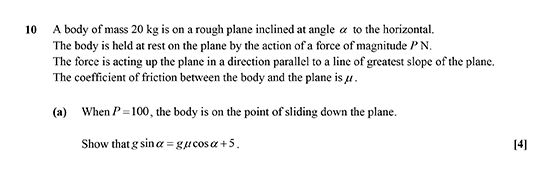
Let’s look at Q10(a) from the Mathematics A H240/03 Sample assessment material as an example.
Here an initial sketch of the context can be used to determine a force diagram, from which the algebra can be stated.
This allows a sense check between the directions of each force and the arithmetic.
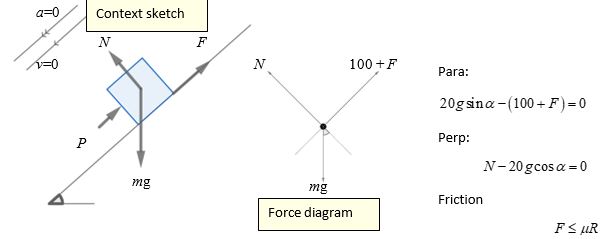
The subsequent algebraic manipulation is not too complex. While mark schemes may not explicitly reward a diagram, any sign errors made by a student can be quickly identified to support the awarding of partial credit.
Modelling assumptions
A common type of question in mechanics is where candidates are asked to make a comment on the model used in the calculations.
Examiners often note that candidates tend to offer extended prose when short bullet points will suffice.
Another issue is where candidates offer generic textbook responses rather than providing an answer that is based on the context of the information provided in the question.
In summary
Mechanics should not be seen as a separate subject to pure maths. Students should be encouraged to recognise that it is simply the application of the pure content to everyday events. The use of careful diagrams helps visualise the mathematical model and provides a sense check of the generated equations.
Stay connected
Sign up for our A Level teacher networks each half term and our professional development webinars.
If you have any questions, you can email us at maths@ocr.org.uk, call us on 01223 553998 or message us on social media. Sign up for subject emails updates for the latest maths news, updates and resources.
If you are considering teaching any of our qualifications, use our online form to let us know, so that we can help you with more information.
About the author
Steven originally studied engineering before completing a PGCE in secondary mathematics. He has taught secondary maths in England and overseas. Steven joined Cambridge OCR in 2014 and worked on the redevelopment of the FSMQ and the A Level Mathematics suite of qualifications. Away from the office he enjoys cooking and to travel. You can follow Steven on BlueSky or Linkedin.
By the same author