A Level Maths: modelling problems involving trigonometry
27 January 2026
Steven Walker, Maths Subject Advisor

At GCSE, trigonometry is mostly about triangles. At A Level, it becomes a powerful tool for modelling real-world situations like tides, Ferris wheels, and pendulums. This short article will look at feedback from examiners to help you understand key ideas, avoid common mistakes, and suggest strategies to boost confidence.
Radians
GCSE and AS maths problems are all set in degrees but at A Level, questions are generally set that can be answered more efficiently using radians. Common sources of errors are students attempting to switch from radians into degrees before attempting to solve the problem or forgetting to switch their calculator between radians and degrees.
Study hint: Use graphing technology to compare trigonometric functions, and their inverses, plotted in both degrees and radians to better understand why calculus and graphing always makes use of radians. For example, this Desmos graph of sin x and sin-1 x.
Q10 H240/01 2019
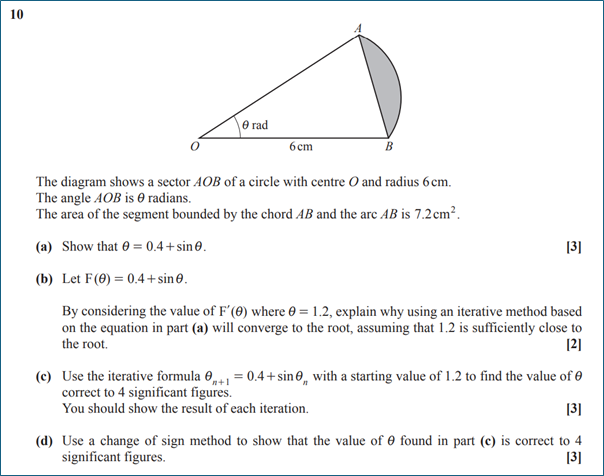
Geometric problems involving sectors or segments can be solved using either radians or degrees, but radians must be used in this exam question which goes into numerical integration.
Exam hint: practice working in both radians and degrees, making sure you know how to switch between units on the calculator.
Trigonometric graphs
Mapping the general shape of sine, cosine, or tangent graphs to the given function can help you visualise solutions.
Study hint: Use graphing technology to investigate the impact of changing coefficients in a trigonometric function. For example, try this Desmos graph of y = a/b sin (c/d x) + p
Q9 H240/01 2024
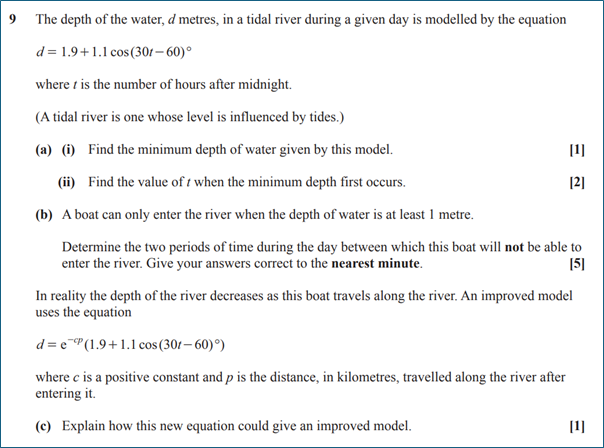
The 1 mark available for part (a)(i) is for spotting that the minimum depth must be when the result of the cosine function is smallest, i.e. cos(x) = – 1. This then leads to finding cos(30t – 60) = – 1 in part (a)(ii). This initial work is scaffolding for the main focus of the problem set in part (b) where a sketch of the function further supports obtaining the answer.
In class, students may wish to investigate Q9 part (c) using this Desmos link and discuss how to find the minimum depth at different points along the length of the river.
Exam hint: sketch the curve of general functions to help visualise solutions.
Forming equations
There is an expectation that A Level students should be able to apply their subject knowledge to generate and solve equations for problems set within an unfamiliar context. Scenarios such as tidal rivers, Ferris wheels, and pendulums offer cyclic relationships that will incorporate trigonometric functions. However, students should be able to extract relevant information to form their own equations to be solved.
Q10 H640/01 2022
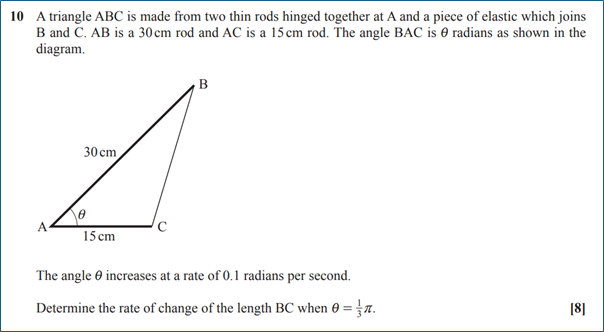
This question links rates of change with lengths and angles of a triangle. When faced with an unusual situation students need think about what techniques they have studied that might be relevant for the information provided, in this case using the cosine rule to find the missing length of the triangle.
Exam hint: Think about what can be found using the given information and then evaluate if this is the missing clue needed for the solution.
Summary
Trigonometric modelling at A Level goes beyond the properties of triangles – it’s about applying concepts to abstract and real-world contexts. Try these three very different questions as part of your revision programme.
Stay connected
Sign up for our A Level teacher networks each half term and our professional development webinars.
If you have any questions, you can email us at maths@ocr.org.uk, or call us on 01223 553998.
Sign up for subject emails to receive the latest maths news, updates and resources.
If you are considering teaching any of our qualifications, use our online form to let us know, so that we can help you with more information.
About the author
Steven originally studied engineering before completing a PGCE in secondary mathematics. He has taught secondary maths in England and overseas. Steven joined Cambridge OCR in 2014 and worked on the redevelopment of the FSMQ and the A Level Mathematics suite of qualifications. Away from the office he enjoys cooking and to travel. You can follow Steven on BlueSky or Linkedin.
Related blogs